
In August, the High Fens on the Belgian-German border burned. The news called it a forest fire. What burned was a peatland, and in a peatland it is the ground itself that burns.
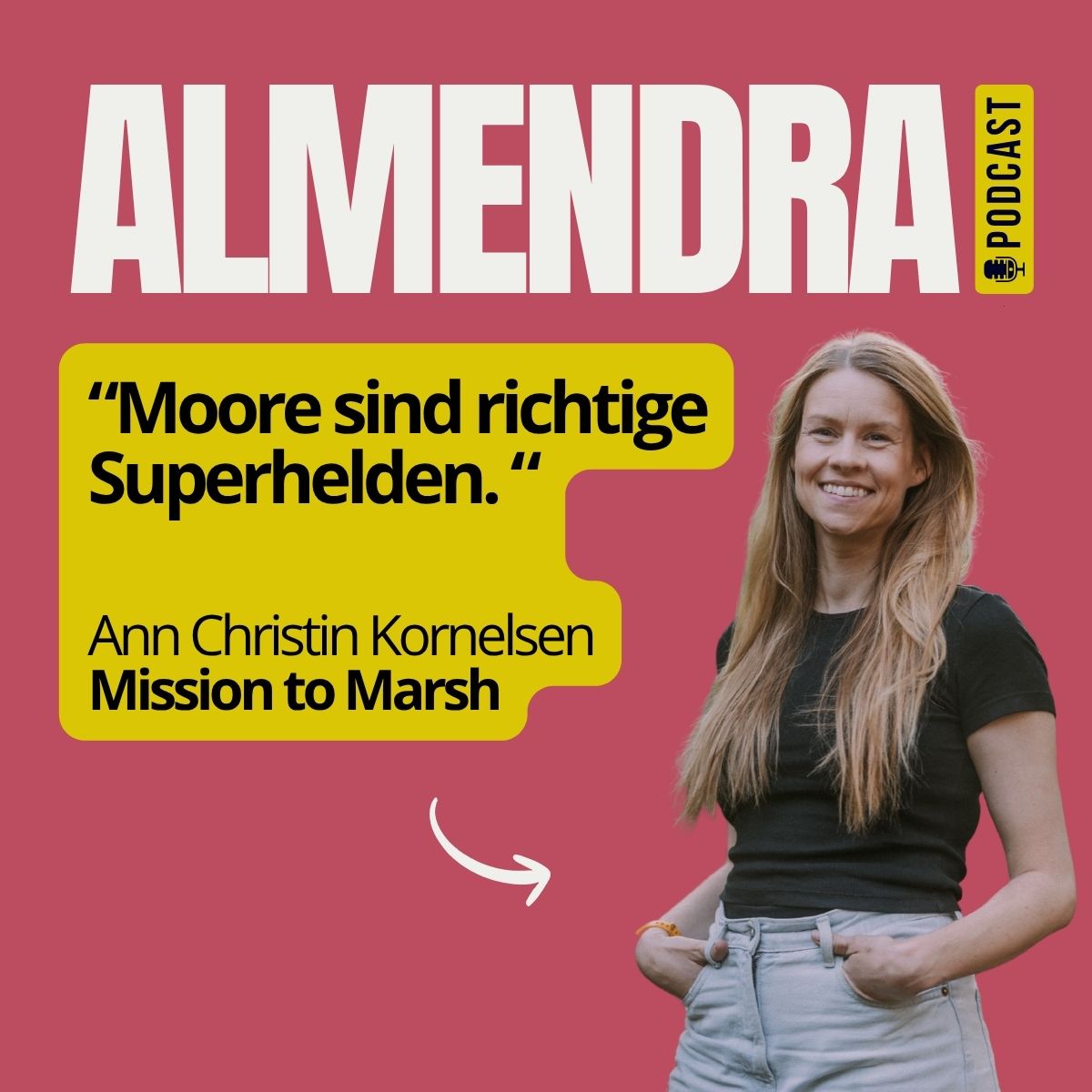
Ann Christin Kornelsen is a peatland scientist. She served as scientific director of the European Peatland and Climate Centre, researches paludiculture and sphagnum mosses at the University of Osnabrück, and founded the non-profit organisation Mission to Marsh with Alex Kornelsen in 2022. In this episode she explains why a peat fire keeps going for months, what can be recovered from 3,000 burned hectares, and why our most effective climate allies are the ones nobody photographs.
When peatlands burn, the ground burns
In a forest fire, what burns is what stands above ground. In a peatland, peat lies beneath the vegetation, and peat is carbon that accumulated there over thousands of years. It burns well. More importantly, it burns inwards: the fire withdraws into the ground and smoulders there long after the surface has gone quiet.
„It wasn't just a forest burning. A peatland was burning."
That is what makes the firefighting so gruelling. You cannot put out a peat fire at the surface and then leave. It takes weeks and months of monitoring to see whether new fires push back up out of the ground. Around 3,000 hectares burned in the High Fens, much of it intact raised bog.
Why the High Fens of all places
German newspaper taz called it a total ecological loss, a Belgian forestry official spoke of irreversible damage. Giving up is a harsh word, says Ann Christin. But the High Fens was one of the largest intact raised bog areas left in this region. What stands there now looks like a moonscape, and the area is lost for decades.
The Fens had been a major restoration project for years. 674 kilometres of drainage ditches were closed there to rebuild the bog. And it burned anyway. The decisive detail: the fire did not start on the intact area. It began where the land had been drained, and spread from there.
„Wet peatlands don't burn, because there is simply that much water in them."
An intact peatland can be 90 percent water, and you can still walk across it. Wherever people drained that water to make the land usable, the peat became vulnerable. Add a dry summer and the odds are high that a fire will reach peat and burn hard. In the Fens, the evidence points to a human cause for the fire as well.
Four superpowers that only work when wet
We are living through a period in which several crises feed into each other: climate change, degraded soils and waters, species loss. There is a natural partial answer to all three, and it is intact peatlands.
They soak up water like giant sponges and protect us from floods. They release it again when we need it most, during droughts. They filter it along the way, which means clean water in rivers, lakes and groundwater. And they are biodiversity hotspots: the insects and amphibians that form the base of our food chain live there.
Then there is carbon. No other ecosystem in our latitudes stores that much of it in so little space. Peatlands only have these abilities while they are intact.
„They are real superheroes when they're intact."
Ann Christin Kornelsen · Almendra PodcastThe image problem: bog bodies and mosquitoes
So why do we talk so much about forests and so little about peatlands? A forest stands there, imposing, instantly recognisable. Over 90 percent of Germany's peatlands have been drained, and we walk past them without noticing.
There is also what peatlands trigger in our heads. I visited one with my primary school class once, and all we talked about were bog bodies. It was terrifying. That image shapes our everyday references, in films and books: fog, mosquitoes, something dangerous underfoot. It is also wrong. Anyone who has walked through a peatland at dawn and heard the cranes knows that.
„I can only love what I know. And I only want to protect what I love."
How to bring a peatland back
Destroyed peatlands are still peatlands, they are simply no longer natural ones. What defines a peatland is the peat in the ground, and that peat is still there under a field or a spruce plantation. Most of Germany's peat soils are used for agriculture and forestry today, alongside peat extraction for soils and growing media, and areas that have been built over.
Restoration works in two steps. First, the vegetation that does not belong there has to come off. Then the drainage is stopped and the ditches are closed. After that, the water comes back on its own.
„It's like putting the plug back into a bathtub."
With a good, rainy winter that can happen very quickly. The only thing that matters is that the water cannot drain away again. Getting the typical peatland plants back takes several years. That process can be accelerated by deliberately spreading sphagnum mosses across the area.
For the climate balance, what counts is the moment the water returns. Dry peatlands are no longer sinks, they release carbon because the peat decomposes. Stop the drainage and those emissions stop fairly quickly. With a forest it takes many years before the trees are large enough to function as a sink at all.
Why protecting peat sometimes means felling trees
The idea that you have to remove trees in the name of climate and nature protection is hard for most people to sit with at first. Ann Christin has an image for it that stays with you: a tree sits in a peatland like a drinking straw. Suck on it and you pull the water out of the area.
This does not apply everywhere, there are peatlands where trees belong. The raised bogs of Lower Saxony are naturally treeless, open and wide. Once you have seen what such an area looks like with the water back, you understand why the spruces do not belong there.
And a burned peatland?
The area in the High Fens is large, and it will take many years. How many depends on how much support the authorities and conservation organisations on the ground receive. If nobody intervenes, nature takes a very long time to restart these processes on its own. There are peat fires from years back whose sites still look like a moonscape.
Ann Christin deliberately declines to judge from a distance which measures are right there. Every peatland is different, and the people working in the Fens have known the area for decades. What helps right now is money for exactly those organisations, because they are best placed to decide where it is needed.
One story from the Fens matters to her nonetheless. For years there were efforts to reintroduce the black grouse there. Many of the released birds did not survive the fire, their transmitters have gone silent. Emergency crews managed to save a single one. The outlook for that population is bad. That firefighters in the middle of an operation like this had the capacity for that one bird still does something to you.
Mission to Marsh: a jab at Mars
Ann Christin and Alex Kornelsen met on Tinder, in the middle of the pandemic, when outdoors was the only option anyway. She took him into a peatland. He is a marketing expert and was looking for work where his skills could do some good. At some point he asked her for a sharp pitch: why are peatlands so great?
„There is no other ecosystem here that can store this much carbon in such a small space. Protecting peatlands is climate protection."
Alex had read a great deal about sustainability. Peatlands barely featured in any of it. That became a non-profit company. The reasoning behind it: rather than planting trees in far-away regions, there are plenty of destroyed peatlands right on our doorstep.
The name is a jab at those who look for water on a distant red planet in order to have a future there. A marsh is a form of wetland. Wherever people found intact ecosystems with plenty of water, they settled. Wetlands are the origin of our civilisation.
The indulgences question
Mission to Marsh works with companies. How do you stop that from becoming a way to buy absolution? Ann Christin takes the question head-on. Classic offsetting runs through certificates: save some carbon, carry on as before. Voluntary carbon certificates exist in peatland protection too.
Her approach is different. For her, peatland protection is more than carbon, it covers the full range of superpowers: biodiversity, water filtration, groundwater recharge. And the partnership is meant to be anchored in a company's strategy rather than in a one-off payment. That includes talks, the documentary film, team activities with staff, and the expectation that the leadership will put on wellington boots and get into the peatland too.
That this works showed early on. It started with a founder's grant from N-Bank and a commitment from Patagonia through the 1% for the Planet programme. Today the green electricity provider ENTEGA protects one square metre of peatland for every new customer.
Where we stand in ten years
If Germany intends to be climate neutral by 2040 or 2050, its peatlands have to be wet by then. Emissions from drained peat soils will no longer be affordable, they have to become sinks again.
Ann Christin's larger hope does not involve depopulating entire regions. Many of these areas are farmed, and there is a concept for that: paludiculture, from palus, the swamp. Peatlands are rewetted and remain economically usable. That field is gaining serious momentum right now.
„Our superheroes are wet."
Ann Christin Kornelsen · Almendra PodcastThe song for difficult days
Almendra always closes by asking for a song that helps. Setting aside the children's music playing in the car with two small kids, Ann Christin recommends Dominik Eulberg. He is a biologist and DJ, makes electronic music and writes tracks for individual bird species. What she loves is the combination: a strong bass and the idea of giving animals a voice. Her pick for the Almendra playlist is the mix „Rohrdommel", named after the Eurasian bittern.
Links & Sources
- Mission to Marsh · protecting peatlands
- Sponsor a square metre of peatland
- The documentary „Mission to Marsh"
- Peatland knowledge: what, how, why
- MOORATHON · donate your movement
- East Belgium: the fire in the High Fens nature reserve
- taz: the major fire in the High Fens
- Greifswald Mire Centre · peatland research and data
- Paludiculture: farming on wet peat soils
- Dominik Eulberg · biologist and DJ
Dominik Eulberg · „Rohrdommel"
Now on the Almendra playlistListen to the full conversation
▶ Go to the episodeOn Spotify, Apple Podcasts, Deezer and Amazon Music