
Almendra Podcast · Delara Burkhardt
“If I had wanted to, I would never have had to speak to a young person again”
In the state election in Saxony-Anhalt, 44 percent of voters aged 18 to 29 voted for the far-right AfD. The Social Democrats took 9 percent in that age group. Turnout among young voters rose by 17.5 points.
Delara Burkhardt was elected to the European Parliament in 2019, aged 26, as the youth candidate of the German Social Democrats’ youth wing. Since October 2026 she has been a Vice President of the S&D Group, responsible for political communication. We talked about how people get into politics, why so many leave again, and what it costs to stay.
A generation that votes
People have been talking about young voters turning away from politics for as long as I can remember. It was a theme when I was at school and again at university. The numbers from the 2026 election year put an end to that story. Turnout among young voters went up everywhere, in Saxony-Anhalt by 17.5 points to 77.8 percent. What they voted for sits at the edges. In Berlin, the Left Party took 47 percent among young people.
Delara Burkhardt knows the story well, and she has little time for it.
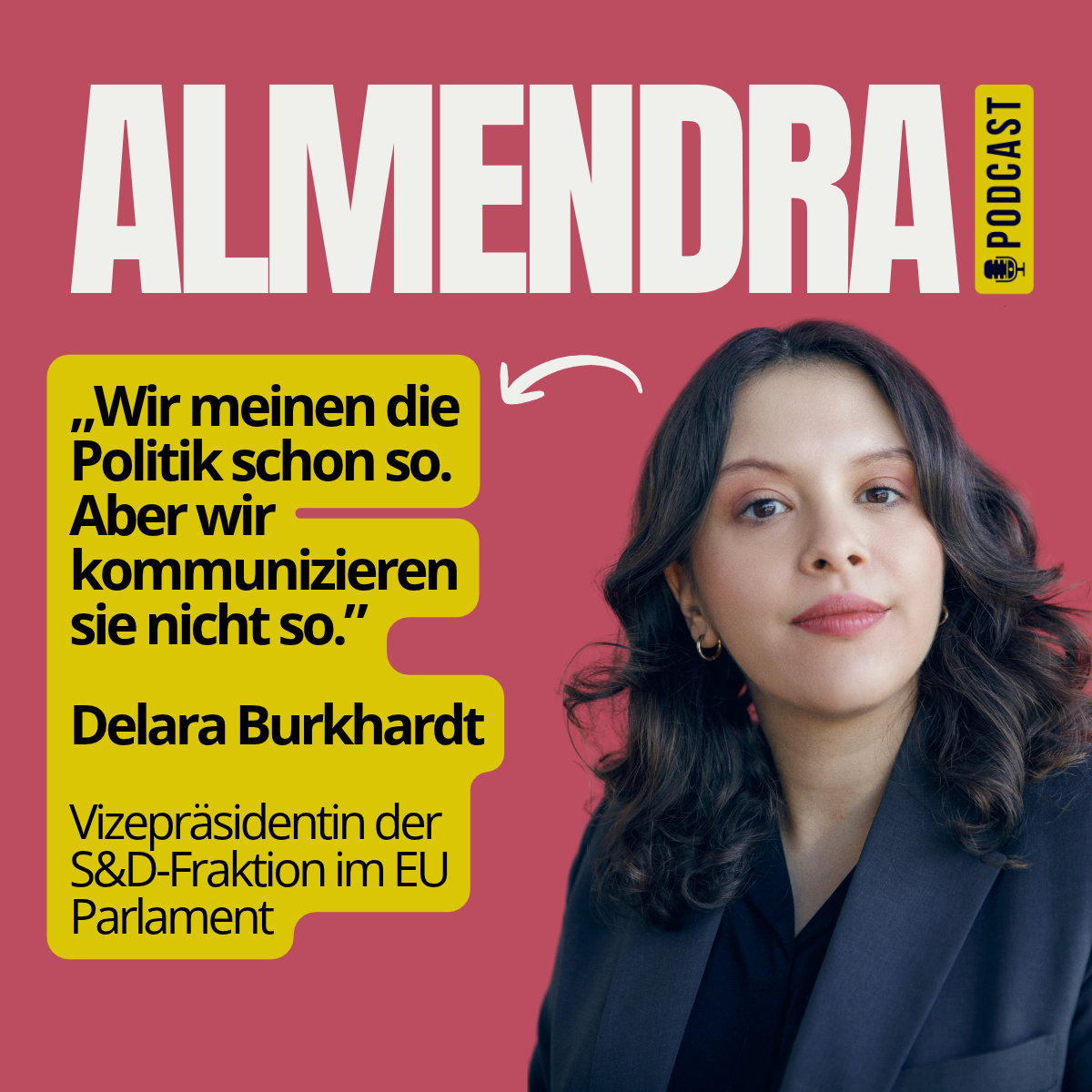
“That myth has been holding on stubbornly for decades. What it actually describes is that young people tend not to feel political processes are there for them.”
Delara BurkhardtHow you get into the European Parliament at 26
For decades there was a German saying about the European Parliament: if you have a grandfather, send him to Europe. Delara arrived in 2019 out of political youth work, with no previous mandate, and she describes her route there as a mix of hard work and coincidence.
Her time with the Jusos, the Social Democrats’ youth organisation, was decisive. Under Kevin Kühnert they ran an internal campaign against the party joining another grand coalition. They lost that vote. Something else worked anyway. Youth inside political parties became visible at all. Before that, plenty of people had no idea that parties even had young members.
The next election was the European one. Delara was on the Juso federal board, responsible for European networking, and the organisation decided to put forward a candidate of its own. This was the period when Fridays for Future was bringing hundreds of thousands onto the streets. The idea was to make that generation an offer instead of only talking about it.
Her day job at the time was at an advertising agency, with party work running alongside it. She had not expected to actually win a seat.
The programme that should not need to exist
Once she got to Brussels her suspicion was confirmed quickly. The people who approach members of parliament are mostly older, organised through associations and writing as individuals. Young people get in touch far less often, because they assume their reality does not feature in day-to-day politics anyway.
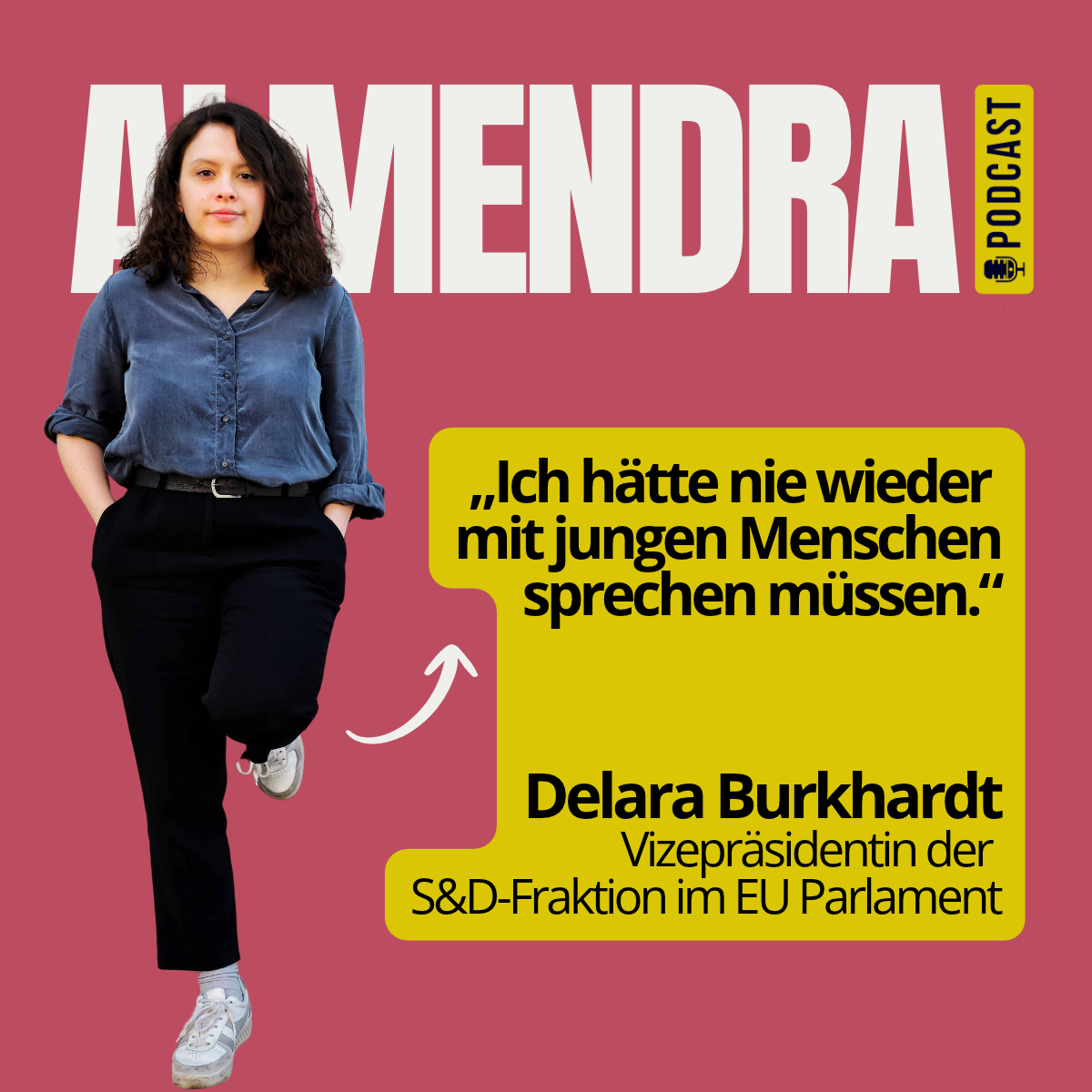
“If I had wanted to, I would never have had to speak to a young person again.”
Delara BurkhardtParliament runs an induction programme for new members. One item on it is called “How to interact with young people”. Coaching, in other words, on how to handle young people, as if they were one homogeneous group you have to do something with.
For Delara that is the first mistake in the thinking. There is no such thing as “young people”. There are, exactly as in the rest of society, people with different perspectives, shaped by where they come from and by the chances they get in life. That flattening is precisely what puts many of them off politics.
What the far right feeds on
The first voting decisions in a life often hold for a long time. When a whole generation makes those decisions out of frustration and fear about the future, the effect runs on for decades. That is exactly what the AfD works with.
“The AfD never says what the better solution for people’s lives would be. Above all, it makes people afraid of the future.”
Delara BurkhardtDelara calls it a major failure of the democratic parties that this gap stayed open for so long. She is also very clear that it is not too late. What is needed is an offer that takes young people seriously in all their variety.
Politics as a service, and why it does not hold
In the conversation I put a line to her that the comedian Aurel Mertz had used in a reel. The SPD, he said, is a Delulu party, one that is relieved not to have dropped out of a state parliament and then celebrates, instead of asking why it is on 9 percent among young voters. Delara did not disagree.
Her own party has a reflex that she considers its biggest communication problem. The campaign slogan “Social policy for you” captures it. Politics appears there as something a party delivers to people.
“People don’t vote for progressive parties because they expect a service. They vote because they want to be empowered, because they want to be part of a project.”
Delara BurkhardtShe points to Zohran Mamdani’s campaign in New York and to successful Democratic candidacies in the US midterms. None of them ran on the promise that one strong individual would sort the world out for everybody else. Each had a different core message: your reality is under-represented in the political process, and I want to change that.
In that logic the acting subject of a party’s politics is not the party. It is the people whose everyday lives change. Her diagnosis of her own party follows from that. The politics is often meant exactly that way, and then communicated differently.
What Europe can learn from Pedro Sánchez
Asked about role models, Delara names the Spanish prime minister. One line of his, delivered at an SPD party conference, stayed with her: anyone who tries to please everyone ends up liked by no one.
Sánchez takes recognisable positions, she says, on international law, on renewables, on reversing privatisation in the health system and on affordable housing. Conflict comes with that, and it is part of the deal. The price of avoiding conflict is higher, because in the end nobody knows what a party is actually fighting for.
Credibility, for her, also includes the ability to name mistakes and correct them, including from a position in government.
What a mandate costs
Delara lives with her family in Kiel, in northern Germany. Her husband works outside politics, and moving the family to Brussels was never an option. She also wants to represent the people of Schleswig-Holstein rather than visit her own region on holiday from Brussels.
Communicating honestly, for her, means naming the price of that openly.
“Arithmetically, I miss a third of my daughter’s year. That makes me incredibly sad.”
Delara BurkhardtThere is a structure behind it. From local councils up to the European Parliament, the political system was built by men for men, with meeting schedules and a culture of presence that sit badly with care work. You can see the result in every party. Women tend to have time for political work either while they are still studying or once the family years are behind them.
When she decided to run again in 2024, the question of starting a family weighed heavily. She struggled with it, because she could not picture a version in which both things worked.
One more night
A small example from her own group shows what change looks like in an operation like this. A male colleague in a leadership role became a father and established that you can stay home on Mondays and travel in on Tuesday morning. One more night with the child, and a signal to everybody else that care work is not an exception to be accommodated.
The conviction underneath is simple and radical at the same time.
The point of it
“At the end of the day we want to be represented by people who have the same struggles and experiences we do.” If that reality does not show up in daily political life, the structures will not change either.
Politics as a job with an end date
The usual question is how to keep women in politics longer. Delara turns it around. What worries her is less the leaving than the staying without self-examination. Plenty of people who sit in parliaments for a long time stop asking themselves why they are standing for office and which lived reality they are carrying into the chamber.
That is why she supports term limits. As she sees it, politics can only be a job with an end date. She applies the same measure to herself, asking what today’s member of parliament still has in common with the Delara who was out on the street with Fridays for Future in 2018.
The letter from 2019
When she was elected, Delara wrote herself a letter. It set out the values she wanted to keep and the red lines she would not cross. The most important one sounds plain and is hard to hold to in daily politics: with every decision she has to be able to look herself in the face and say that this compromise is better than what it risks.
There were moments when she could not. On European asylum policy she refused, under heavy pressure, to back what was on the table. Children in detention was the line.
“I was very proud to see that I had stuck to it.”
Delara Burkhardt on her 2019 letterWhat she tells young women
Delara often gets messages from people who want a career in politics and want to know how it works. Her answer shifts the question. Anyone who wants to become something has a harder time of it than someone who wants to achieve something and can remind themselves of that when it gets difficult.
The second part matters just as much and is rarely said out loud. You need allies, inside the political bubble and outside it. People who know you well, whom you trust, and who will tell you honestly when it is your own convictions talking and when it is the apparatus.
She confirms without hesitation that it is harder for women. Male voices get more attention in a room, and the background noise rises when a woman speaks. Authority is often tied to age, even though everyone in the European Parliament is elected with the same mandate, whether they are in their early twenties or their mid-seventies.
The song for difficult days
At the end of every episode we ask for a song that helps when things get heavy. Delara’s choice has little to do with its title and everything to do with energy: “Boom Boom Back” by Hinds, a band from Madrid.
Listen to the episode
The full conversation runs around 30 minutes, in German, and is available wherever you get your podcasts.
Links and sources
- Delara Burkhardt at the European Parliament
- delara-burkhardt.eu
- The S&D Group in the European Parliament
- Three election wins, three political answers, Das Progressive Zentrum (in German)
- Voting behaviour in Saxony-Anhalt by age and gender, ZDFheute
- A look back at the 2026 election year, taz
- Study on the falling share of women in local councils, Ruhr University Bochum
- Hinds, Boom Boom Back